

Sexual Harassment2026-09-15T22:50:58-07:00

EMPLOYEE-SIDE EMPLOYMENT LAW FIRM

Los Angeles Sexual Harassment Lawyers

Helping employees confront workplace sexual harassment and protect their careers.

Free and confidential consultation • No fees unless we recover
Spanish, Armenian, Farsi, and French are spoken.

Los Angeles Sexual Harassment Attorneys at the Genie Harrison Law Firm

You Deserve to Feel Safe and Respected at Work

Sexual harassment can threaten your career, financial security, and sense of safety at work. If you are afraid of retaliation or uncertain whether what happened was unlawful, you do not have to make those decisions alone.

Genie Harrison Law Firm, APC represents employees who have experienced workplace sexual harassment in Los Angeles and throughout California. We help clients understand their rights, protect themselves from retaliation, and pursue accountability and compensation under California law.

We understand how difficult it can be to come forward—particularly when your job, professional reputation, and financial stability may be at risk. Our attorneys will listen, explain your options, and guide you through each stage of the legal process.

Disability Discrimination Can Take Several Forms

TYPE ONE

Quid Pro Quo Harassment

Employment benefits or decisions are conditioned on submitting to sexual conduct.

TYPE TWO

Hostile Work Environment Harassment

Unwelcome conduct is so severe or pervasive that it creates an intimidating, hostile, or offensive work environment.

Examples of Workplace Sexual Harassment May Include:

  • Unwanted sexual comments, jokes, or questions

  • Inappropriate emails, texts, photographs, or images

  • Unwanted touching or physical contact

  • Repeated advances after rejection

  • Requests or demands for sexual favors

  • Threats or promises involving employment opportunities

  • Retaliation after reporting or opposing misconduct

Sexual harassment does not always involve physical contact, and the harasser does not necessarily have to be a supervisor. If you are uncertain whether what happened may violate California law, an attorney can evaluate the circumstances and explain your options.

What to Do If You’re Being Sexually Harassed

What you do next may affect both your safety and your legal rights. Consider taking the following steps:

1

Document what happened.

Record dates, locations, witnesses, statements, and other relevant details while they are still fresh.

2

Preserve available evidence.

Save relevant emails, texts, messages, photographs, performance reviews, and workplace records when you can lawfully do so.

3

Review your reporting options.

Consider your employer’s reporting procedures, but prioritize your safety and speak with an attorney if you are concerned about retaliation.

4

Consult an employment lawyer.

Learn about your rights before making decisions that could affect your employment or potential claim.

You do not need perfect documentation to speak with an attorney. A lawyer can help you determine what evidence may be available and how best to proceed.

Filing Deadlines for Sexual Harassment Claims

California law limits the time you have to act.

In most cases, you must file a complaint with the California Civil Rights Department (CRD) within three years of the harassment.

Missing a deadline can prevent you from bringing a claim. An attorney can help ensure you file your claim correctly and on time.
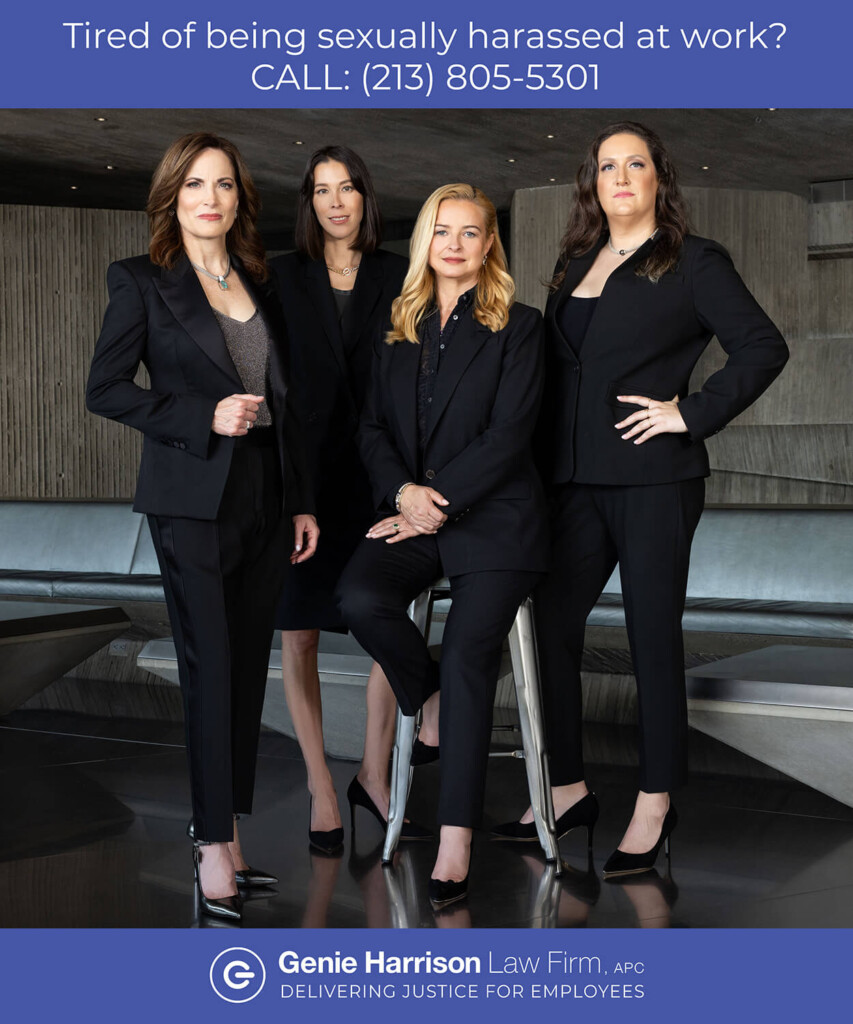
sexual harassment attorneys

Experienced Sexual Harassment Lawyers Representing Employees

The Genie Harrison Law Firm focuses exclusively on representing employees—not employers.

Genie Harrison has been recognized by Consumer Attorneys of California as Attorney of the Year for her work on high-profile sexual harassment cases, including litigation involving Harvey Weinstein.

Our firm has handled complex sexual harassment, discrimination, and retaliation cases throughout California, including claims against major corporations.

Our attorneys know how to:

  • Investigate workplace misconduct
  • Build strong legal claims
  • Navigate California employment law
  • Take cases to trial when necessary

From consultation through resolution, we are your advocate every step of the way.

  • We represent employees only
  • Decades of experience in employment law
  • Proven results in harassment and retaliation cases
  • Trial-ready attorneys
  • Personalized, client-focused representation
  • No fees unless we win
  • Selective caseload to maximize attention to each client

Award-winning sexual harassment attorney Genie Harrison

Genie Harrison’s Work on the Harvey Weinstein Cases

In 2022, Consumer Attorneys of California named Genie Harrison Consumer Attorney of the Year. She earned the honor for representing survivors in cases involving Hollywood producer Harvey Weinstein. In her acceptance speech, Genie explains how her own experiences with sexual harassment and assault shaped her commitment. She is committed to holding perpetrators accountable and seeking justice for survivors.

sexual harassment attorney Genie Harrison is a survivor

PERSONAL EXPERIENCE. PURPOSEFUL ADVOCACY.

A Survivor Who Understands the Courage It Takes to Come Forward

Genie Harrison brings both professional experience and personal understanding to her work representing employees and survivors. She knows that coming forward can feel overwhelming—especially when a person’s career, reputation, or sense of safety may be at risk.

Her approach begins with listening, explaining the available options clearly, and helping each client move forward with strength and dignity.

“I understand how difficult it can be to come forward. That understanding shapes how I listen, how I advocate, and how I fight for my clients.”

— Genie Harrison

Sexual harassment lawyer Genie Harrison featured in Super Lawyers Magazine

SUPER LAWYERS® MAGAZINE COVER STORY

Why Genie Harrison Became an Advocate for Survivors

Genie Harrison has experienced sexual harassment and assault, and she understands the pain and suffering that victims may experience. Read Genie’s story in Super Lawyers Magazine about how her personal experiences as a victim of sexual abuse have made her a victim’s rights attorney. She and her team can help you to take back your power.

Frequently Asked Questions About Sexual Harassment

How long do I have to file a disability discrimination claim in California?2026-09-15T23:19:37-07:00

In general, an employment discrimination complaint must be initiated with the California Civil Rights Department within three years of the alleged discriminatory act. An employee who wants to file a lawsuit under California’s Fair Employment and Housing Act must ordinarily obtain a right-to-sue notice from the Department first. After receiving that notice, the employee generally has one year to file a lawsuit.

Different claims may carry different or shorter deadlines, and determining when a deadline began can be complicated. Employees should consult an employment lawyer promptly rather than assume they have three years to act.

Can my employer retaliate against me for requesting an accommodation?2026-09-15T23:18:41-07:00

No. It is unlawful for an employer to retaliate against an employee for requesting a reasonable accommodation or asserting rights protected by disability-discrimination laws.

Retaliation may include termination, demotion, reduced hours, undesirable assignments, increased scrutiny, exclusion from workplace opportunities, threats, or other materially negative treatment. The requested accommodation does not necessarily have to be granted for the request itself to be protected. Employees who experience negative treatment after requesting an accommodation should document the timing, communications, and reasons given by the employer.

Can my employer fire me while I am on medical leave?2026-09-15T23:17:59-07:00

Being on medical leave does not give an employee absolute protection from termination. An employer may still make a lawful employment decision for a legitimate reason unrelated to the employee’s disability, leave, or accommodation request.

However, an employer generally may not fire an employee because of a protected disability, for taking legally protected leave, or for requesting a reasonable accommodation. Before terminating an employee who needs additional disability-related leave, the employer may also be required to engage in the interactive process and consider whether a finite extension of leave or another accommodation would be reasonable.

Can my employer ask for medical documentation?2026-09-15T23:17:22-07:00

In some circumstances, yes. When a disability or the need for an accommodation is not obvious, an employer may request reasonable medical documentation confirming that the employee has a disability-related limitation and needs an accommodation.

The request should be limited to information relevant to the employee’s restrictions and accommodation needs. An employer generally should not demand complete medical records, unrelated medical information, or more information than is reasonably necessary. When both the disability and need for accommodation are obvious, additional medical documentation may not be appropriate.

What is the interactive process?2026-09-15T23:16:43-07:00

The interactive process is a timely, good-faith discussion between an employer and an employee about the employee’s work-related limitations and possible reasonable accommodations.

The process may include identifying the essential functions of the position, reviewing relevant restrictions, discussing possible accommodations, and determining whether an accommodation would be effective. Employers should not ignore an accommodation request or reject it without meaningful consideration.

An employer may also have an obligation to initiate the interactive process when it becomes aware that an employee may need an accommodation—even if the employee has not used the words “reasonable accommodation.”

Can medical leave be a reasonable accommodation?2026-09-15T23:16:01-07:00

Yes. A finite period of medical leave may be a reasonable accommodation when it is likely to allow an employee to recover and return to work. This may be true even if the employee has exhausted available sick leave, FMLA leave, CFRA leave, or leave provided under an employer’s policies.

Employers generally do not have to provide leave that is indefinite or would create an undue hardship. However, an employer should not automatically terminate an employee simply because a standard leave period has expired. The employer may need to discuss whether additional leave or another accommodation would allow the employee to return.

Can working remotely be a reasonable accommodation?2026-09-15T23:13:29-07:00

Yes. Remote or hybrid work can be a reasonable accommodation when it allows an employee to perform the essential functions of the job without creating an undue hardship for the employer.

Remote work is not automatically required in every case. The employer may consider the employee’s duties, whether those duties can be performed away from the workplace, and whether another effective accommodation is available. A blanket rule requiring every employee to work on-site does not necessarily relieve an employer of its obligation to evaluate an accommodation request individually.

What is a reasonable accommodation?2026-09-15T23:12:44-07:00

A reasonable accommodation is a change to the job, workplace, schedule, or customary way of working that allows a qualified employee with a disability to perform the essential functions of the position.

Depending on the circumstances, accommodations may include a modified schedule, additional breaks, an accessible workspace, assistive equipment, medical leave, remote work, modification of nonessential duties, or reassignment to a vacant position.

An employer does not necessarily have to provide the employee’s preferred accommodation if another effective option is available. However, the employer generally must provide an effective accommodation unless doing so would create an undue hardship.

Does a temporary illness or injury qualify as a disability?2026-09-15T23:11:57-07:00

It can. A condition does not necessarily need to be permanent to qualify as a disability under California law. A temporary injury, illness, or medical condition may be protected if it limits a major life activity.

Examples could include a broken bone, pneumonia, recovery from surgery, or another condition that temporarily affects an employee’s ability to work or perform daily activities. The determination depends on the nature and effects of the condition—not simply how long it is expected to last.

What qualifies as a disability under California employment law?2026-09-15T23:10:18-07:00

California employment law broadly defines a disability as a physical or mental condition that limits a major life activity, such as working, walking, concentrating, communicating, sleeping, or caring for oneself. Protected conditions may include physical injuries, chronic illnesses, cancer, diabetes, mobility impairments, depression, anxiety, PTSD, and other mental health conditions.

California law may also protect employees who have a history of a disability or whose employers mistakenly believe they have a disability. Whether a particular condition qualifies depends on the facts and how the condition affects the employee.

How long do I have to file a wrongful termination claim in California?2026-09-13T22:54:37-07:00

The deadline depends on the legal basis for the claim. Different time limits may apply to discrimination, retaliation, whistleblower, contract, wage-related, and public-policy claims. Some matters may also require an administrative complaint before a lawsuit can be filed.

Because waiting can affect both your legal rights and the availability of evidence, it is important to speak with a California employment attorney promptly. An attorney can identify the potential claims, determine the applicable deadlines, and advise you about the proper filing process.

What compensation may be available in a wrongful termination case?2026-09-13T22:53:49-07:00

The compensation available depends on the facts, the legal claims involved, and the harm caused by the termination. Depending on the circumstances, recoverable damages may include:

  • Lost wages and employment benefits
  • Future lost earnings
  • Compensation for emotional distress
  • Attorney’s fees and litigation costs when authorized by law
  • Punitive damages in certain cases

Reinstatement or other nonmonetary relief may also be available in some matters. No particular outcome can be guaranteed, and every wrongful termination case must be evaluated individually.

What should I do after a possible wrongful termination?2026-09-13T22:53:13-07:00

Preserve evidence and create a written timeline as soon as possible. Relevant materials may include:

  • Termination notices
  • Performance evaluations
  • Disciplinary records
  • Employment agreements
  • Employee handbooks and workplace policies
  • Emails and text messages
  • Communications with Human Resources
  • Names of potential witnesses
  • Records of complaints, leave requests, or accommodation requests

Keep only information you are legally entitled to possess. Do not access your former employer’s systems without authorization or remove confidential company materials.

You should also be cautious about signing a severance agreement or release before understanding how it may affect your rights.

Is it wrongful termination if I was fired while on medical leave?2026-09-13T22:52:32-07:00

It may be. California and federal laws provide qualifying employees with certain rights involving medical leave, disability accommodation, pregnancy-related leave, and family leave.

Being on leave does not protect an employee from every otherwise lawful employment decision. However, an employer may violate the law if it terminates an employee because the employee requested or took protected leave, needed a reasonable accommodation, or had a qualifying disability or medical condition.

The reason given for the termination, the timing of the decision, and the communications between the employee and employer may all be important.

Can my employer fire me after I report harassment or discrimination?2026-09-13T22:51:38-07:00

An employer cannot lawfully terminate you because you made a good-faith complaint about conduct you reasonably believed was harassment, discrimination, or another violation of employment law.

Retaliation can include termination, demotion, reduced hours, reassignment, discipline, exclusion from important meetings, or other adverse treatment. Suspicious timing between a complaint and a termination may be relevant, but timing alone does not always prove retaliation.

Save copies of complaints, responses from management or Human Resources, performance reviews, and other relevant communications that you may lawfully retain.

How can I tell if my employer’s stated reason for firing me is false?2026-09-13T22:50:47-07:00

Employers frequently give a lawful-sounding explanation for a termination, such as poor performance, restructuring, or a reduction in force. That explanation may be a pretext if the evidence suggests the employer’s real reason was unlawful.

Possible warning signs include:

  • The employer’s explanation changes over time.
  • Your performance history contradicts the stated reason.
  • You were terminated shortly after making a protected complaint.
  • The employer departed from its normal disciplinary procedures.
  • Other employees were treated differently under similar circumstances.
  • Your position was quickly filled by someone outside your protected group.

No single fact necessarily proves wrongful termination. An employment attorney can evaluate the timing, documents, witnesses, and treatment of comparable employees.

Can I be wrongfully terminated from an at-will job?2026-09-13T22:50:00-07:00

Yes. Although most California employees are considered at-will, that does not give employers the right to fire someone for an unlawful reason.

An at-will employee may generally be terminated with or without advance notice, provided the decision does not violate an employment law, contractual obligation, or established public policy. For example, an employer cannot lawfully fire an at-will employee because of the employee’s race, sex, age, disability, pregnancy, protected leave, whistleblowing, or complaint about unlawful workplace conduct.

What qualifies as wrongful termination in California?2026-09-13T22:46:23-07:00

Wrongful termination occurs when an employer fires an employee for a reason prohibited by law, in violation of an employment agreement, or contrary to an established public policy.

Examples may include terminating an employee because of discrimination, retaliation, whistleblowing, protected medical or family leave, a request for reasonable accommodation, or a complaint about unpaid wages or unsafe working conditions.

A termination can feel deeply unfair without necessarily being illegal. The critical question is why the employer made the decision and whether that reason violated an employee’s legal rights.

What are the two types of sexual harassment?2026-09-13T22:38:30-07:00

Sexual harassment generally falls into two categories:

Quid pro quo: Job benefits are conditioned on sexual conduct.

Hostile work environment: Ongoing unwelcome conduct creates an abusive workplace.

What should I do if I’m being harassed?2026-09-13T22:39:55-07:00
  • Document what happened
  • Save evidence
  • Report it if possible
  • Speak with an attorney
How do I know if I am a victim?2026-09-13T22:40:19-07:00

If the conduct is unwelcome and creates an uncomfortable or intimidating work environment, it may qualify as sexual harassment. A sexual harassment attorney in Los Angeles can help evaluate your situation.

Can my employer retaliate against me?2026-09-13T22:40:37-07:00

No. California law prohibits retaliation for reporting harassment. If your employer demotes or fires you, or treats you unfairly, you may have an additional legal claim.

Do I need proof to file a claim?2026-09-13T22:40:56-07:00

No. While documentation helps, many cases rely on testimony and patterns of behavior.

You Don’t Have to Face This Alone

If you believe you’ve been sexually harassed at work, you don’t have to determine your legal options alone. Tell us what happened. Our team will listen, explain your rights, and help you consider the best path forward.

Compensation Available in a Sexual Harassment Case

California law may entitle victims of workplace sexual harassment to compensation that can include:

  • Emotional distress damages

  • Lost wages and benefits

  • Future lost earnings

  • Attorney’s fees and costs

  • Punitive damages in certain cases

An experienced sexual harassment lawyer can evaluate the circumstances and explain what compensation may be available.

No Fees Unless We Recover for You

We represent clients in sexual harassment cases on a contingency-fee basis.

  • No upfront attorney’s fees

  • No hourly attorney’s fees

  • You pay no attorney’s fees unless we obtain a recovery for you

We believe every employee deserves access to strong legal representation, regardless of their financial circumstances.

Your consultation is free and confidential. Contacting us does not obligate you to take legal action.

Tell Us About Your Case

For a free and confidential consultation, complete the form below or call us at (213) 805-5301.

    Your Name (required)

    Email Address (required)

    Phone Number (required)

    How would you like to be contacted? Check all that may apply:

    EmailPhone

    May we have your consent to share your contact information with another law firm should we decide to refer your matter. Please note that the details of your matter are not shared and will remain confidential. (required)
    Yes, you have my consent.No

    How did you hear about us:

    Type of case. Check all that apply:

    Wrongful TerminationSexual HarassmentOther HarassmentDiscriminationDisability DiscriminationEqual Pay for Women / Gender DiscriminationRetaliationWhistleblower RetaliationWage & Hour ViolationsFraudSeverance NegotiationOther Employment IssueSexual Assault At Work or SchoolI Am A Caregiver

    How can we help you? (Brief description of your legal issue)

    MOBILE APPS

    Read about the mobile apps created by Genie Harrison to help victims.

    go to mobile apps for victims

    CONTACT US

    Tell us about your case.

    los angeles employment lawyers

    GENIE HARRISON LAW FIRM, APC
    23975 Park Sorrento, Suite 202, Calabasas, CA 91302

    Go to Top